
MATATAG Curriculum 2026 – Complete Guide, Subjects, Lesson Plans & PDF Downloads
Quick answer: The MATATAG Curriculum is the Department of Education’s revised K to 10 basic education program in the Philippines. It replaced the overloaded K to 12 curriculum with fewer subjects, fewer competencies, and more time for reading, math, and values. DepEd is rolling it out in phases from School Year 2024–2025 to 2027–2028 under DepEd Order No. 010, s. 2024. On this page you will find the complete MATATAG Curriculum guide — subjects for every grade, rollout schedule, grading system, lesson plan help, free tools, and PDF downloads.
The DepEd MATATAG Curriculum is the biggest change in Philippine basic education in more than a decade. Are you a teacher preparing lessons? A parent checking what your child will learn? Or a student who wants to know what changed? This page pulls everything together in one place. You also get a link to a full guide for every topic.
Here is the biggest change: the MATATAG Curriculum cuts learning competencies by more than 70 percent. Teachers finally get time to teach for mastery instead of rushing through a packed list of topics. Learners get a stronger foundation in literacy and numeracy, plus clear values formation from Kindergarten to Grade 10.
Download MATATAG Curriculum Guides (PDF) — Free
Most visitors come here for one thing: the guides. So here they are, right at the top. Pick your subject, read the plain-words explainer, and get the official DepEd PDF from there.
Need the official file itself? Get it free from the DepEd MATATAG Portal or the DepEd Learning Resource Portal.
MATATAG Grade Finder & Class Program
Pick a grade. See its rollout year, subjects, and daily schedule in seconds.
Choose your grade level

MATATAG Curriculum at a Glance
| Detail | What You Need to Know |
|---|---|
| Program | MATATAG Curriculum — revised K to 10 basic education curriculum |
| Issued by | Department of Education (DepEd), Philippines |
| Legal basis | DepEd Order No. 010, s. 2024 (pilot first ran under DepEd Order No. 54, s. 2023) |
| Grade levels | Kindergarten to Grade 10 |
| Rollout | Phased, School Year 2024–2025 to 2027–2028 |
| Competencies | Cut by over 70% — from more than 11,700 down to about 3,664 |
| Tagline | “Bansang Makabata, Batang Makabansa” (A Nation for Children, Children for the Nation) |
| Motto | Matatag na Edukasyon, Matatag na Karakter |
What Does MATATAG Mean?
The word matatag is Filipino. Its meaning is “strong,” “firm,” “steady,” or “resilient” — in English, MATATAG means a foundation that does not easily break. That is exactly what DepEd wants every Filipino learner to have. Read our full explainer on the MATATAG meaning and motto for the story behind the name.
MATATAG is also the name of DepEd’s reform agenda, and each letter group stands for a clear goal:
- Ma — Make the curriculum relevant, so learners become competent, job-ready, active, and responsible citizens.
- Ta — Take steps to speed up the delivery of basic education facilities and services.
- Ta — Take good care of learners through well-being, inclusive education, and a positive learning environment.
- G — Give support to teachers so they can teach better.
The MATATAG logo carries the same message: a heart at the center for care, and strong strokes that stand for a steady, resilient system.
Watch: MATATAG Curriculum Overview
Short on time? Watch this overview video first — it walks through what the MATATAG Curriculum is and how the new program works:
Why DepEd Replaced K to 12 with the MATATAG Curriculum
The DepEd new curriculum did not appear out of nowhere. It was DepEd’s answer to a real learning crisis:
- In PISA 2018, Filipino learners ranked at or near the bottom in reading, mathematics, and science.
- A 2022 World Bank report found that about 91% of Filipino children aged 10 could not read and understand a simple text — a problem called learning poverty.
- Teachers were overloaded. The K to 12 curriculum packed in more than 11,700 competencies, so classes moved fast but understanding stayed shallow.
- Subjects overlapped, topics repeated across grade levels, and some content was not right for the learners’ age.
In short, learners were memorizing more but understanding less. Something had to change.
The MATATAG Curriculum fixes this by decongesting the curriculum, going back to foundational skills, and giving teachers room to teach well. If you want the side-by-side details, read our full comparison of the MATATAG Curriculum vs K to 12.
MATATAG Curriculum vs K to 12: The Main Differences
| Area | K to 12 Curriculum | MATATAG Curriculum |
|---|---|---|
| Learning competencies | More than 11,700 | About 3,664 (over 70% less) |
| Grade 1 subjects | 7 subjects | 5 subjects only |
| Teaching focus | Coverage of many topics | Mastery of essential skills |
| Early grades | Many subjects at once | Strong focus on reading and math first |
| Values education | EsP as one subject | GMRC and Values Education given more time and weight |
| Assessment | Heavier reliance on written tests | Balanced: written works, performance tasks, and quarterly assessment |
| Curriculum guides | Long, dense guides | Streamlined DepEd curriculum guide per learning area |
| Rollout | Started 2012 | Phased rollout, SY 2024–2025 to 2027–2028 |
Short on time? The one-line summary: MATATAG keeps the K to 10 structure but removes the congestion, so learners master the basics before moving on. Our guide to the curriculum revision process explains how DepEd reviewed and rebuilt the program, and the ways forward page shows where the reform goes next.
Purpose of the MATATAG Curriculum
So what is all this for? Four things, mainly.
First, to end learning poverty. A child who cannot read by age 10 struggles in every subject after that. MATATAG attacks that problem head-on, in the early grades, where it starts.
Second, to raise whole persons, not just passers of exams. Graduates should be skilled, honest, healthy, and proud to be Filipino — people who can think for themselves and care for others.
Third, to help Filipino learners compete anywhere. Strong reading, math, science, and communication skills open doors here and abroad.
And fourth, to build a system that lasts — one that can adjust when the world changes, instead of breaking down every few years.

The Four Pillars of the MATATAG Curriculum
Teachers often call them the four pillars of MATATAG. Every subject, guide, and classroom routine points back to these four:
1. A Relevant, Decongested Curriculum
DepEd removed overlapping and non-essential competencies so learners become competent and job-ready, not just good at memorizing. Fewer topics, learned deeply, beat many topics learned halfway.
2. Faster Delivery of Basic Education Services
Classrooms, learning materials, and support services should reach schools on time. The rollout pairs the new guides with teacher training and updated resources every school year — see the latest MATATAG Curriculum news and DepEd updates.
3. Learner Well-Being and Inclusive Education
Learners come first. The curriculum protects student well-being, welcomes learners of all abilities and backgrounds, and builds a positive learning environment in every classroom.
4. Real Support for Teachers
Teachers get clearer guides, lesson exemplars, and training. The official DepEd Teacher’s Guide walks teachers through each learning area, and teacher salary grade updates are tracked on this site too.
Salient Features of the MATATAG Curriculum
Decongested Learning Content
This is the heart of the reform. With competencies cut by over 70%, Grades 1 and 2 carry only five subjects. Teachers can slow down, check understanding, and reteach when needed. Think of it this way: fewer lessons, but learned properly.
Strong Focus on Foundational Skills
Reading and mathematics get protected time in the early grades through the National Reading Program and the National Mathematics Program (NMP). A child who reads well and computes confidently in Grade 3 can handle every subject that follows. Our guide to the NRP subject explains how reading time works in class.
Balanced Assessment
Grades no longer rest on written tests alone. Formative checks during lessons, performance tasks, and quarterly assessments work together — the full breakdown is in the grading section below.
Personalized Learning
No two learners move at the same speed, and MATATAG finally admits that. Teachers can adjust activities, groupings, and pacing to fit the class in front of them. A slow learner gets support early. A fast learner gets a harder task. Nobody has to pretend the whole class is the same.
Inclusive and Equitable Education
MATATAG is built for every learner. Children with disabilities get support through SPED and their own education plans. Muslim learners learn through the Madrasah Education Program. And learners in regular classes get activities that match their level. No one is left out of the system.
Instructional Design Framework (IDF)
Lessons follow DepEd’s Instructional Design Framework, which moves teachers away from passive lectures and toward active, learner-centered classes. We break it down step by step in our Instructional Design Framework guide, including how the medium of teaching and learning is chosen for each grade.
Relevant Skills for Real Life
Book knowledge alone is not enough anymore. Across subjects, learners build four skill groups:
- Communication and interpersonal skills — speaking, writing, listening, and working with others.
- Media, technology, and information skills — finding, checking, and using information wisely.
- Innovation and learning skills — critical thinking, creativity, and problem-solving.
- Life and career skills — practical skills for work, business, and daily life.
How to Use the Official MATATAG Curriculum Guide
The MATATAG Curriculum Guide is the master document for each learning area. It lists the content standards, performance standards, and the learning competencies teachers must develop each quarter. Compared with the old K to 12 guides, each curriculum guide is shorter and clearer, because it focuses on the Most Essential Learning Competencies (MELCs). Our MELCs Curriculum Guide explains how the essential competencies were picked and how to unpack them into daily lessons.
A practical way to use the guide:
- Start with the quarter’s content and performance standards.
- Unpack each competency into smaller, teachable skills.
- Match the competency to a lesson exemplar or your own lesson plan.
- Plan your assessment at the same time — not after the lesson.
- Check pupil mastery before moving to the next competency.
DepEd publishes the official guides for free. You can get them from the official DepEd MATATAG Curriculum portal and the DepEd Learning Resource Portal. The downloads section below gathers our plain-language guide for every subject, so you can understand each official guide faster.

MATATAG Curriculum Subjects by Grade Level
The MATATAG Curriculum subjects change as learners grow. Early grades stay light and focused; later grades add specialized subjects one stage at a time. This table shows the full K to 10 picture, with a link to our complete guide for each grade.
| Grade Level | Subjects / Learning Areas | Full Guide |
|---|---|---|
| Kindergarten | Makabansa, Languages, Mathematics, GMRC, Physical and Natural Environment (taught through play-based learning blocks) | Kindergarten Curriculum Guide |
| Grade 1 | Language, Reading and Literacy, Mathematics, Makabansa, GMRC (5 subjects) | Grade 1 Subjects |
| Grade 2 | Language, Reading and Literacy, Mathematics, Makabansa, GMRC (foundation subjects continue) | Key Stage 1 Guide |
| Grade 3 | Language, Reading and Literacy, Mathematics, Makabansa, GMRC, with Filipino and English strengthening | Key Stage 1 Guide |
| Grade 4 | Filipino, English, Mathematics, Science, Araling Panlipunan, MAPEH, EPP, GMRC (8 learning areas) | Grade 4 Subjects |
| Grade 5 | Filipino, English, Mathematics, Science, Araling Panlipunan, MAPEH, EPP, GMRC | Grade 5 Subjects |
| Grade 6 | Filipino, English, Mathematics, Science, Araling Panlipunan, MAPEH, EPP, GMRC | School Calendar 2026–2027 |
| Grade 7 | Filipino, English, Mathematics, Science, Araling Panlipunan, MAPEH, TLE, Values Education (8 learning areas) | All Subjects in Grade 7 |
| Grade 8 | Filipino, English, Mathematics, Science, Araling Panlipunan, MAPEH, TLE, Values Education | Grade 7–10 Subjects Guide |
| Grade 9 | Filipino, English, Mathematics, Science, Araling Panlipunan, MAPEH, TLE (specialized), Values Education | TLE Curriculum Guide |
| Grade 10 | Filipino, English, Mathematics, Science, Araling Panlipunan, MAPEH, TLE, Values Education | Grade 10 Subjects |
Parents often ask how many subjects their child will take. The short answer: 5 learning areas in Kindergarten, 5 subjects in Grades 1 to 3, and 8 learning areas from Grade 4 to Grade 10. For junior high, our page on all subjects in Grade 7 lists every subject and what it focuses on. And the time allotment per subject guide shows the exact minutes per day for each learning area.
Key Changes in Each Grade Level
- Kindergarten: Still play-based, now aligned to the new pillars, with a stronger bridge to early reading and math.
- Grade 1: The biggest cut — from 7 subjects down to 5, so young learners are not overloaded.
- Grade 2: Same lean setup as Grade 1; Filipino and English are introduced step by step.
- Grade 3: Reading tasks get harder, and Science joins the line-up.
- Grade 4: Filipino and English become separate subjects; Science, Araling Panlipunan, and MAPEH start formally.
- Grade 5: A consolidation year — deeper history and civics, multi-step math problems, guided science inquiry.
- Grade 6: Science and Math are decongested further, to get learners ready for junior high.
- Grade 7: TLE starts, with exploratory courses in ICT, agriculture, and home economics.
- Grade 8: Values Education deepens, with peace education and ethical decision-making woven into subjects.
- Grade 9: TLE gets more specialized, helping learners spot their senior high track early.
- Grade 10: The final K to 10 year — research projects and practical demonstrations replace pure memorization.
MATATAG Curriculum Rollout Schedule (2024–2028)
DepEd is phasing in the DepEd MATATAG Curriculum so schools, teachers, and materials can keep up. Here is the official schedule:
| School Year | Grade Levels | Phase |
|---|---|---|
| 2024–2025 | Kindergarten, Grade 1, Grade 4, Grade 7 | Phase 1 |
| 2025–2026 | Grade 2, Grade 5, Grade 8 | Phase 2 |
| 2026–2027 | Grade 3, Grade 6, Grade 9 | Phase 3 |
| 2027–2028 | Grade 10 | Full Implementation |
This means the first complete MATATAG K to 10 cohort — children who entered Kindergarten in SY 2024–2025 — will finish Grade 10 in 2034. For opening-of-classes dates, holidays, and quarterly schedules, see the official DepEd school calendar for 2026–2027. The background paper behind the whole reform is explained in our MATATAG Shaping Paper guide.
Free Tool: MATATAG Grade Finder & Class Program
Not sure when your grade starts MATATAG, or what its daily schedule looks like? Try the free tool below. Pick a grade and you will see its rollout year, its subjects, and a sample class program in seconds. Teachers use it at the start of every school year — parents use it too.

MATATAG Curriculum Guides and PDF Downloads (Per Subject)
Looking for a specific curriculum guide? Start with our plain-language explainer for that subject, then download the official PDF from DepEd. Each guide below explains the competencies quarter by quarter, in words a busy teacher or parent can actually use.
| Learning Area | Our Complete Guide | What It Covers |
|---|---|---|
| Science | Curriculum Guide in Science | Quarterly topics, inquiry skills, and experiments for Grades 3–10 |
| Mathematics | Mathematics Curriculum Guide | Number sense, operations, and problem-solving progression per grade |
| Filipino | Filipino Curriculum Guide | Reading, writing, and grammar competencies in Filipino |
| English | English Curriculum Guide | Listening, speaking, reading, and writing skills per quarter |
| Araling Panlipunan | Araling Panlipunan Guide | Philippine history, civics, and culture from Grade 4 to 10 |
| MAPEH | MAPEH Curriculum Guide | Music, Arts, PE, and Health in one learning area |
| Music and Arts | Music and Arts Guide | The split MAPEH components for Grades 4–10 |
| PE and Health | PE and Health Guide | Movement, fitness, and health competencies |
| TLE / EPP | TLE Curriculum Guide | ICT, agriculture, home economics, and industrial arts |
| GMRC | GMRC Curriculum Guide | Values formation for the early and middle grades |
| GMRC vs Values Education | GMRC vs Values Education | Which one your grade level teaches, and why both exist |
| Makabansa | Makabansa Curriculum Guide | National identity and community for Grades 1–3 |
| Kindergarten | Kindergarten Curriculum Guide | Play-based learning blocks and developmental domains |
| Mother Tongue / RA 12027 | RA 12027 Explained | What the new mother tongue law changed in Grades 1–3 |
Official downloads: DepEd releases the official MATATAG Curriculum PDF files for free. Always get the official file from the DepEd MATATAG portal or the LR Portal — third-party copies are often outdated or incomplete. Our guides above tell you what is inside each PDF before you download it.
Lesson Plans, Class Programs, and Free Teacher Tools
A guide alone does not run a classroom. These resources turn the MATATAG Curriculum into daily teaching:
- How to Make a MATATAG Lesson Plan — the parts of the plan, the format DepEd expects, and a worked example.
- MATATAG Lesson Plan PDF — a ready reference you can download and keep.
- Exemplar Lesson Plan — what a model lesson looks like, with a template you can copy.
- Sample Class Program — a weekly schedule template that fits the official time allotment.
- Time Allotment per Subject — minutes per subject, per grade level, in one table.
- SF10 (Form 137) Checker Tool — our free interactive tool that checks a learner’s SF10 purpose and records before you print or release it.
- Rapid Mathematics Assessment (RMA) — how the RMA works and how to read the scores.
What Should a MATATAG Lesson Plan Include?
A complete plan usually has these parts:
- Learning objectives based on the curriculum standards
- Subject and grade level
- The learning competencies for the lesson
- Lesson content
- Teaching and learning activities
- Learning resources and materials
- Assessment activities
- Support or enrichment activities for learners who need them
You do not have to make all of this from scratch. DepEd shares lesson exemplars through the LR Portal, and our guides above show how to adapt them to your class.
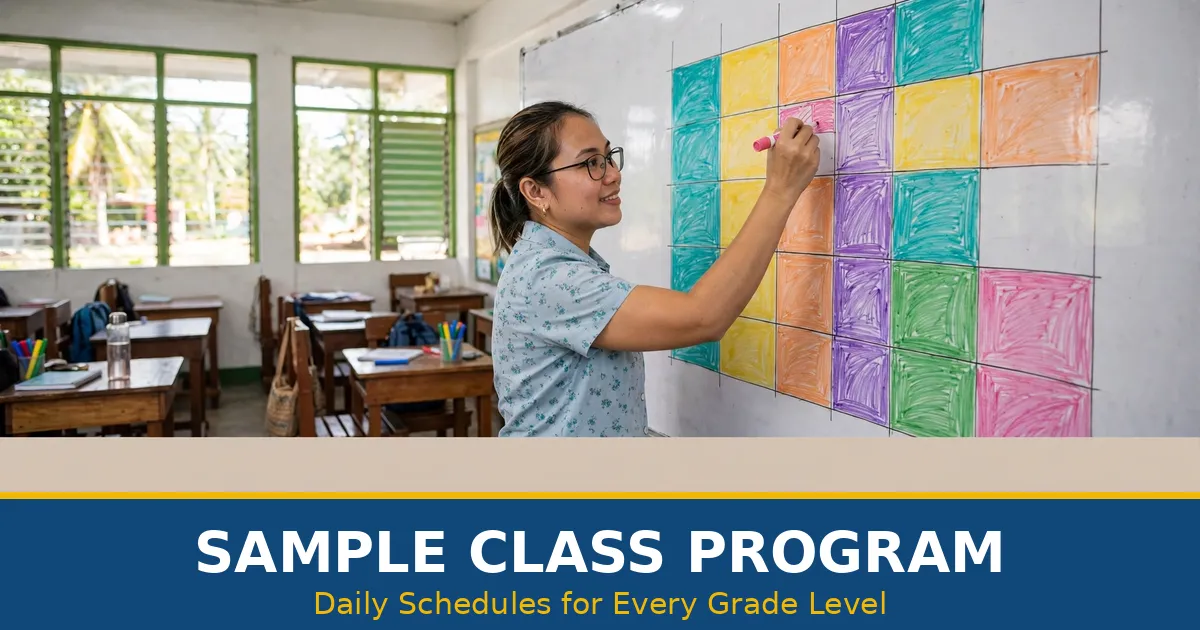
MATATAG Class Program: How Schools Build the Daily Schedule
The class program is the school’s daily map. It shows who teaches what, to which class, and at what time. Under MATATAG, schools build it from the official time allotment for each grade — not from habit.
What a MATATAG Class Program Includes
- Grade level and section
- Subject or learning area
- The teacher assigned to each subject
- Time allocated for each class
- School days and class periods
- Break and lunch periods
- Classroom or learning space, when needed
How Schools Create a MATATAG Class Program
- Identify the grade level.
- List the required learning areas for that grade.
- Check the prescribed instructional time per subject.
- Assign qualified teachers.
- Distribute the subjects across the week.
- Add breaks and other school activities.
- Review the schedule for conflicts.
- Share the final program with teachers and students.
MATATAG Class Program Example
Here is a simple weekly example for an intermediate class. Your school’s version will follow the latest DepEd time allotment, so treat this as a pattern, not a rule:
| Time | Monday | Tuesday | Wednesday | Thursday | Friday |
|---|---|---|---|---|---|
| 7:30–8:30 | Mathematics | English | Mathematics | English | Mathematics |
| 8:30–9:30 | Filipino | Science | Filipino | Science | Filipino |
| 9:30–10:00 | Break | Break | Break | Break | Break |
| 10:00–11:00 | Science | Mathematics | English | Mathematics | English |
| 11:00–12:00 | Araling Panlipunan | Filipino | Science | Filipino | Araling Panlipunan |
Why the class program matters: a clear program keeps the whole week steady. Teachers can prepare for their real periods, learners know what each day brings, and school heads can spot teacher conflicts or room shortages before classes even start. Want the full per-grade schedules instead? Use the free Grade Finder tool above — it builds the daily program for Kindergarten to Grade 10.

MATATAG Grading System: How Grades Are Computed
Under the MATATAG Curriculum, quarterly grades combine three components — Written Works, Performance Tasks, and the Quarterly Assessment — with weights that depend on the learning area (DepEd Order No. 020, s. 2024):
| Learning Areas | Written Works | Performance Tasks | Quarterly Assessment |
|---|---|---|---|
| Languages (English, Filipino), Araling Panlipunan, EsP / Values Education | 30% | 50% | 20% |
| Mathematics, Science | 40% | 40% | 20% |
| MAPEH, EPP / TLE | 20% | 60% | 20% |
Scores are transmuted to a 0–100 scale, and 75 is the passing mark. Our full MATATAG grading system guide shows the step-by-step computation with sample grades, the transmutation table, and how the final report card grade is built.

Benefits of the MATATAG Curriculum
For Learners
- A stronger reading and math foundation that later subjects can build on.
- Less cramming and more real understanding, because there are fewer topics to rush.
- Life skills — critical thinking, communication, collaboration — practiced in class, not just tested.
- A clearer sense of Filipino identity through Makabansa and values formation.
For Teachers
- Fewer competencies to cover, so lessons can go deeper.
- Clearer, lighter curriculum guides and ready lesson exemplars.
- Assessment that gives useful feedback during the quarter, not only after it.
- Training and professional development paired with every rollout phase.
For Parents
- A clearer picture of what your child should learn each quarter.
- More feedback from teachers, because teachers are no longer racing the clock.
- Foundations that prepare learners for senior high school — see the SHS Curriculum Guide for what comes after Grade 10.
For the Nation
- A workforce that can actually read, compute, and think — the base of any growing economy.
- Better results in national and international assessments over time, as foundations improve.
- Citizens with shared values and a shared identity, which makes communities stronger.
Challenges Teachers Should Prepare For
An honest guide names the hard parts too. Schools rolling out the DepEd new curriculum 2026 phase and beyond report the same challenges:
- Training at scale. Hundreds of thousands of teachers need MATATAG training, and one session is rarely enough. Many teachers are openly asking for more training and coaching, not just one seminar. Join your school’s LAC sessions and keep the exemplars close.
- Learning materials arrive late in some areas. Keep digital copies of the guides from the LR Portal as backup, and share printed exemplars within your grade level.
- Large class sizes. Learner-centered activities are harder with 45+ pupils. Group roles and station work help more than whole-class lectures.
- Old habits: mass promotion. Passing learners who have not mastered the basics works against MATATAG’s mastery goal. Use formative checks early so remediation happens inside the quarter.
- Monitoring and feedback. A reform this big needs honest data. Schools should track what is working, report problems early, and adjust — guessing helps no one.
- School forms changed too. Keep your records straight with our SF10 checker and the DepEd uniform and DepEd logo guides for official branding.
What Happens After Grade 10? Senior High School
MATATAG K to 10 feeds into the strengthened Senior High School program. Core subjects in SHS drop from 15 to about 5–7, strands give way to flexible Academic and TechPro tracks, and learners get more electives and real work immersion. If your child is in Grade 9 or 10, read the SHS Curriculum Guide and the HUMSS strand courses page to plan early.
Teacher Quick-Start Checklist
- Download your learning area’s MATATAG Curriculum Guide from the DepEd portal.
- Read the quarter’s standards, then unpack the MELCs into weekly skills.
- Build or adapt a lesson plan using our lesson plan guide.
- Set your class program using the official time allotment.
- Plan Written Works and Performance Tasks with the grading weights in mind.
- Run quick formative checks every week — do not wait for the quarterly exam.
- Keep learner records updated, and verify SF10 data with the free checker tool.
The Future of the MATATAG Curriculum
The reform will be judged by results: better reading and math scores, lower learning poverty, and stronger performance in national and international assessments. DepEd continues to adjust guides and training based on classroom feedback, and this site tracks every change — bookmark the MATATAG news page and the Teachers’ Day Philippines guide for the stories around the reform. Done well, MATATAG gives the Philippines something it has wanted for years: fewer lessons, learned properly, by every child.
Conclusion
The MATATAG Curriculum is not a small edit of the old program. It is a reset: fewer competencies, stronger foundations, fairer assessment, and real support for the people inside the classroom. It will not fix Philippine education in one school year — no curriculum can. But it points in the right direction, and for the first time in years, teachers have room to teach and learners have room to learn.
Keep this page bookmarked. We update it whenever DepEd releases a new guide, order, or schedule.
Frequently Asked Questions
The MATATAG Curriculum is DepEd’s revised K to 10 basic education program in the Philippines. It replaces the crowded K to 12 curriculum with fewer competencies, a stronger focus on reading and math, and clearer values formation. DepEd is rolling it out in phases from SY 2024–2025 to SY 2027–2028.
MATATAG is DepEd’s reform agenda: Make the curriculum relevant, Take steps to speed up the delivery of basic education services, Take good care of learners, and Give support to teachers. The word itself means strong and resilient in Filipino.
MATATAG keeps the Kindergarten-to-Grade-10 structure but cuts learning competencies by over 70%. Early grades carry fewer subjects, assessment is balanced across written works, performance tasks, and quarterly tests, and values education gets more time. The comparison table on this page shows the full breakdown.
Official MATATAG Curriculum PDFs are free on the DepEd MATATAG portal and the DepEd Learning Resource Portal (LR Portal). Use official sources only — third-party files are often old versions. The download box at the top of this page links to a plain-words guide for every subject.
It depends on the grade. Kindergarten has 5 learning areas, Grades 1 to 3 have 5 subjects, and Grades 4 to 10 have 8 learning areas. The subjects table on this page lists every grade level.
Not yet. School Year 2026–2027 covers Kindergarten to Grade 9 (Phase 3). Grade 10 joins in SY 2027–2028, which completes the rollout. This current phase is what many people call the DepEd new curriculum 2026 phase.
MELCs are the Most Essential Learning Competencies — the must-learn skills that every learner has to master. The MATATAG guides are built around them, which is why the new guides are much shorter than the K to 12 versions.
Quarterly grades combine Written Works, Performance Tasks, and the Quarterly Assessment. The weights differ by subject: 30/50/20 for Languages, Araling Panlipunan, and Values Education; 40/40/20 for Math and Science; and 20/60/20 for MAPEH and EPP/TLE. The passing grade is 75.
TLE (Technology and Livelihood Education) covers ICT, agriculture, family and consumer science, and industrial arts for Grades 7 to 10. Grades 7–8 learn common competencies. Grades 9–10 specialize, and prepare for entrepreneurship or TESDA certification paths.
No. DepEd Order No. 010, s. 2024 directs both public and private schools offering basic education to follow the MATATAG Curriculum on the same phased schedule.
Honestly, the problems so far are mostly about the transition, not the design. Teachers need a lot of training in a short time. Some learning materials arrive late. Class sizes are still large in many schools, which makes learner-centered teaching harder. And any new system has an adjustment period — the first years are the hardest.
Learners build communication and interpersonal skills, media and technology skills, critical thinking and creativity, and life and career skills. The goal is a graduate who can work with others, check information wisely, solve new problems, and keep learning long after school.
The Shaping Paper is the DepEd document that explains the thinking behind the reform — why the curriculum had to change, what the evidence showed, and how the new design answers it. Our MATATAG Shaping Paper guide explains it in plain words.
Yes. Every rollout phase comes with teacher training and professional development. DepEd also provides updated curriculum guides, lesson exemplars, and teaching resources each year, so teachers keep improving their practice instead of learning the system once and being left alone.
Start with DepEd’s Learning Resource Portal (LR Portal), where you can search by learning area, grade level, and resource type. DepEd also releases official lesson exemplars for each phase. On this site, our lesson plan guide and lesson plan PDF show the format and a worked example.
Sources and References
- Department of Education. DepEd Order No. 010, s. 2024 — Policy Guidelines on the Implementation of the MATATAG Curriculum.
- Department of Education. DepEd Order No. 54, s. 2023 — Pilot Implementation of the MATATAG Curriculum.
- Department of Education. DepEd Order No. 020, s. 2024 — classroom assessment and grading guidelines for the MATATAG Curriculum.
- Department of Education. MATATAG Curriculum Guides (Kindergarten, Grades 1, 4, 7 and succeeding phases) — deped.gov.ph.
- OECD. PISA 2018 Results.
- World Bank. The State of Global Learning Poverty (2022) — Philippines learning poverty brief.
- DepEd. MATATAG: Bansang Makabata, Batang Makabansa agenda launch (2023) and the MATATAG Shaping Paper.
This page is a free teacher-and-parent resource maintained by matatagcurriculums.com. It is not an official DepEd website — for official documents, always refer to deped.gov.ph.